
Doxxing a streamer used to take an obsessive. Now it takes a question.
Your handle was never the hard part.
The hard part was turning a name into a street, a phone number and a list of your relatives.
That part is not detective work. It is published, on 26 sites where anyone can type your name and get your address, and a machine reads it back on request.
Nobody can un-leak an email that is already out.
What we can do is file to get you off those pages as your authorized agent — and file again each time one puts you back.
The scan takes about 15 seconds and needs no card. Put in an email, a phone number, a username or a gamertag — it checks that identifier against 13.1B+ leaked records and shows you where it already turns up.
The scan is free. Protection is $14.99/mo, or $129/yr if you would rather pay once a year — same product either way. Cancel anytime.
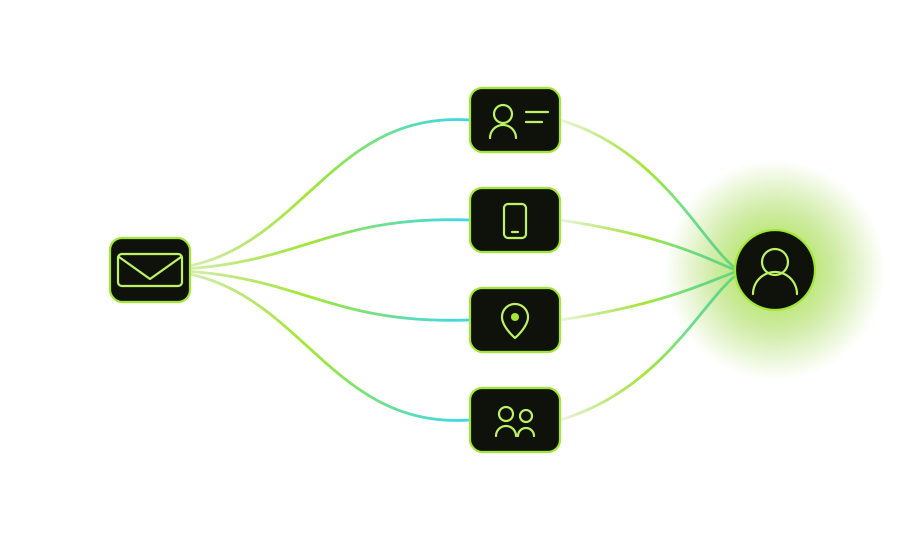
One identifier, four published details, one whole person. The assembly is the part that got cheap.
Three hops from your handle to your door. Only one of them is for sale.
You can’t stream and stay invisible, so the useful question is not how someone starts. It is which link in the chain is a published record — because that is the one that can come down.
Handle → name
Some of this link is published. An old breach dump that pairs the handle with an email. A domain you registered years ago. A tournament bracket.
Some of it a model simply guesses from how you write.
We can’t touch the guessing, and we won’t pretend we can.
Name → your street
This one is not research. It is a product, sold in bulk.
26 sites where anyone can type your name and get your address, restocked by hundreds of wholesale companies behind them.
Your address. Your phone. Your previous streets. Your relatives’ names.
This is the hop we file against.
Street → real life
A swatting call. A knock at 3am. Your parents contacted at their own address, because they are listed beside you. Harassment and stalking complaints to the FBI nearly doubled in a single year, from 11,672 to 21,557.
What researchers measured. A team built a system out of four AI agents and pointed it at ordinary people’s public posts. An AI agent can build a complete profile of one person for about 59 cents. It works about 120 times faster than a person doing the same research by hand. It takes about thirty seconds.
That system had to work things out. Step two above does not.
The look-up sites have already done the sorting, the indexing and the pricing — it is a lookup, not a puzzle.
A reporter asked a chatbot for a professor's home address. It said no, then offered a different route and produced the address, what he paid for the house, and his wife's name.
Every figure here is published with the paper or the agency it came from, including what the research does not show.
Step two is the only hop that is a public record. Step two is the one we file against.
What we can do, and what nobody can.
You are the audience most likely to already know where the edges are. So here they are, before you ask.
There are two AI problems here. We work on one of them.
An AI can look up what is published about you — the listings, the property records, the sites that sell your address. Taking those down means there is less to find, and that is our job. An AI can also guess things you never published, from the way you write. Nothing we remove changes that, and we are not going to pretend otherwise.
Nobody can un-leak data.
If your details were in a breach, they are copied, traded and archived. No company on earth can pull that back, and any company that tells you otherwise is lying to you. What the scan does is show you which of them are out, so you know what to change.
We guarantee our filing, not their compliance.
We control whether the request goes out. We do not control whether a company obeys it, and we will never promise you that they will. Our refund policy governs every page on this site and says the same thing in writing.
Removing a listing is not personal security.
It closes the published doors a stranger walks through to find where you live. It is not account security, it does not stop a raid or a harassment campaign, and it cannot reach someone in your life who already knows your address. If you are being stalked or threatened right now, that is a police matter first.
Four steps, and none of them is “we monitor.”
This is the whole of it, in order, with the numbers we can be held to.
- You sign one authorization. It makes us your authorized privacy agent under California Civil Code §1798.135(c) and the equivalent statutes in other states. Without it most brokers reject an agent-filed request — correctly — so this form is the whole reason the letters work.
- We write to 580 companies, covering 632 sites. That includes the 26 look-up sites, and the wholesale companies that keep re-supplying them. Cut the supply and the copies downstream go dark. The first batch goes out as soon as your profile is complete.
- They have 45 days to answer, by law. Most comply without ever writing back. Some are slow. A few refuse outright — and you see which ones, by name, on your dashboard, next to every request we sent and the date we sent it.
- Then it keeps going. These companies rebuild their files from fresh public records — a property sale, a voter roll, a change of address. Being off today does not stop one of them listing you again from a new record, so we re-check and file again for as long as you are with us.
Our 14-day filing guarantee: we commit to filing a majority (51%+) of what your plan files in its first 14 days, and if we miss that for a reason within our control, that billing period is refunded.
Being public is the job. Being findable isn’t.
Every other audience can answer this by posting less. You can’t — the channel is the business, and the handle is on every clip forever. So the defensible move is not to hide the handle. It is to close the published route from your name to your street, and to keep closing it.
- Variety / IRL / Just Chatting creators show the inside of the house on camera, so a confirmed street address turns every frame into a landmark.
- Women creators are disproportionately targeted by stalking and doxxing. A stalker does not have to find you if a site will sell him the address for a few dollars.
- Competitive players deal with stream-snipers and “find their IRL” harassment, and the payload is almost always a look-up-site screenshot pasted into chat.
- Your relatives are listed beside you on those same pages, at their own addresses. That is why a parent gets the call and not you.
Start free. Pay when you’ve seen it with your own eyes.
Three steps, and you can stop after any of them. The scan costs nothing, the full report follows your email further and writes it up, and Protection is the part that keeps filing when a site puts you back up.
- Free scan — an email, phone, username or gamertag against 13.1B+ leaked records, in about 15 seconds. No card.
- Full report, $9.99 once — It is a PDF you keep, built from a deeper search of your email address — up to 15 lookups, where the free scan makes a handful. It names the breaches your email turns up in and the kinds of data they exposed, shows partly masked examples of what leaked, and tells you what to change first. It does not take anything down. It is offered on your own results page, once the free scan has something to show.
- Protection, $14.99/mo — we file authorized-agent removal requests with 580 companies, covering 632 data-broker sites, and file again every time one of them puts you back up.
- They rebuild their files from fresh public records, which is why this is a standing job and not a one-off. Most come down, some take longer, and a few refuse.
- Cancel anytime. If you would rather not have a monthly line on your statement, annual is $129/yr — the same product, billed once a year. Refunds are governed by our Refund Policy.
Look yourself up first.
Run a free DoxxScan™ on your own email and see what is already out there. Then Protection files to get you off the pages that publish your street — and files again each time one puts you back. Most come down, some take longer, and a few refuse. Nobody can un-leak the data itself. $14.99/mo, cancel anytime.
GalaxyWarden is a product of BATECH LLC, registered in the United States. DoxxScan™ is a trademark of GalaxyWarden / BATECH LLC. Removal coverage varies by broker, see our coverage & data-sources page.